Straight answers before the drill comes out
29 real questions from Denver-metro homeowners, HOA boards, and facility managers — costs, methods, climate, soil, and Ordinance 307.
Cost
What Denver-metro homeowners and property managers actually pay.
Most jobs run from a couple hundred dollars for a single crack repair up to several thousand for resurfacing or lifting an entire driveway or patio. Cost depends on damage type, repair method, and square footage — we confirm an exact, fixed number after walking the property, not over the phone.
Simple sealant work on hairline cracks typically runs about $5–$8 per linear foot, chiseled-and-filled structural cracks about $8–$15 per linear foot, and epoxy injection with reinforcement on wider structural cracks about $15–$25+ per linear foot — a single epoxy injection job commonly totals around $250–$500.
A basic single-color resurfacing usually runs about $3–$5 per square foot, resurfacing over more extensive surface damage up to roughly $9 per square foot, and decorative stamped or textured overlays about $7–$20 per square foot depending on the finish.
Almost always. Injection, resurfacing, and lifting typically cost a fraction of full tear-out and re-pour, and they preserve an existing finish — stamped pattern, exposed aggregate, integral color — that a brand-new slab can't replicate. We'll say so plainly when a slab really is past the point where repair makes sense.
Repair vs. Replace
How we decide, and what to look for before we ever get on site.
If it's a single piece with surface-level damage — cracking, scaling, minor unevenness — and it sounds solid when tapped, repair is almost always the right call. If it's broken into several large pieces, has deep spalling exposing corroded rebar across a wide area, or has heaved and settled so badly leveling can't restore a usable surface, replacement is the honest answer.
Usually, yes. The crack itself is rarely the underlying structural problem — it's typically a symptom of clay-soil movement or freeze-thaw stress beneath the slab. Injecting and sealing the crack, then addressing the cause, commonly restores the slab for years without a full replacement.
Not usually. Scaling is a surface-level condition — the top layer flaking away — and can typically be resurfaced or overlaid as long as the base slab underneath is still sound. Full replacement becomes necessary mainly once scaling has progressed into deep, widespread spalling with exposed, corroded rebar.
Done correctly — epoxy-injected cracks, properly bonded overlays, corrosion-treated spall patches — repairs restore functional strength and, with a sealing schedule against future freeze-thaw and salt exposure, can outperform an unprotected original surface. The goal is stopping the damage cycle, not just covering it up.
Freeze-Thaw & Winter Damage
Why Front Range winters are uniquely hard on Denver-metro concrete.
The Front Range averages roughly 149 freeze-thaw cycles a year — far more than most U.S. metros — because Denver's cold nights paired with 300+ days of strong sunshine mean concrete repeatedly thaws and refreezes all winter long, rather than staying frozen for weeks at a time. Each cycle, trapped water expands about 9% as it freezes, widening existing micro-cracks a little further.
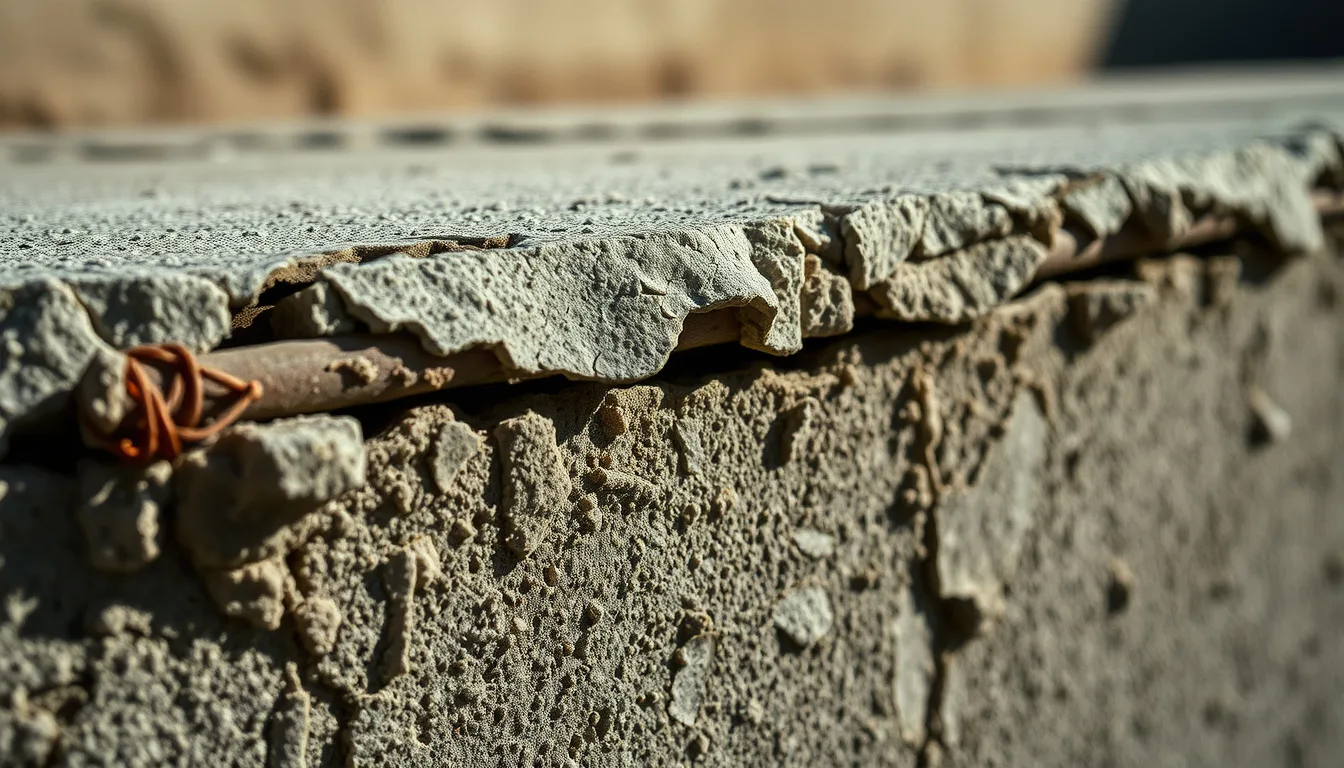
Scaling is the thin surface layer flaking or peeling away to expose rougher aggregate underneath. Spalling is larger chunks breaking off, usually at edges, corners, or control joints. Cracking is an internal stress fracture reaching the surface. On Denver-metro concrete, these are often stages of the same freeze-thaw and salt-exposure damage compounding over successive winters.
Slightly, in the higher-elevation edges of the metro like far-south Highlands Ranch and western Wheat Ridge foothill-adjacent properties, where intense high-altitude sun can thaw snow and ice even while air temperature stays below freezing, driving a faster melt-refreeze cycle than lower, flatter parts of Denver proper.
Sealing exposed concrete before winter, keeping joints and cracks filled so water can't pool and freeze inside them, and specifying air-entrained concrete on any new pour or resurfacing all meaningfully cut freeze-thaw damage. We build sealing and joint maintenance into every repair so the fix isn't undone by next winter.
De-Icing Salt & Scaling
Magnesium chloride, calcium chloride, and what each does to a slab.
Yes. The magnesium chloride widely used across Denver-metro roads and the calcium chloride common on private driveways and walkways both increase how much water the concrete's pore structure holds, which intensifies freeze-thaw expansion and speeds up surface scaling.
Yes, measurably. Testing shows magnesium chloride produces noticeably more surface scaling than an equivalent calcium chloride application, and it's also far more corrosive to embedded steel rebar — documented as more than twice as corrosive as calcium chloride on some steels, and up to roughly 10x more corrosive to mild steel.
Yes — chloride ions from de-icer eventually reach embedded rebar and break down the layer that normally protects it from corrosion. Rusting steel expands and physically cracks and spalls the surrounding concrete from the inside, which is how surface scaling can progress into deeper structural spalling if it goes unaddressed.
Sealing the concrete creates a barrier that reduces how much salt-laden water penetrates the surface, and choosing a less corrosive de-icer on your own property — calcium chloride or a sand-based traction product instead of magnesium chloride — slows future scaling. We recommend sealing as part of most Denver-metro repair jobs specifically for this reason.
Expansive Clay Soil & Heave
Pierre Shale, bentonite, and why flatwork moves even when your house doesn't.
Much of the Denver metro sits on Pierre Shale and bentonite clay layers that swell dramatically when wet and shrink when dry — the Colorado Geological Survey has documented seasonal ground movement of roughly 2–6 inches in affected areas. Homes are commonly built on drilled piers reaching stable bedrock, but driveways, walks, patios, and garage slabs almost never are, so flatwork moves with the clay even when the foundation stays put.
Bentonite is the common name for montmorillonite, the swelling clay mineral inside Pierre Shale and similar formations found throughout the metro. Pure montmorillonite can expand up to 15 times its dry volume, and even the diluted concentrations found in typical Front Range soil can swell enough to crack foundations and heave pavement — a well-documented regional hazard, not a fringe concern.
It can, if the clay underneath keeps swelling and shrinking seasonally — which is why a proper repair addresses drainage (keeping water away from the soil under and around the slab) alongside the concrete work itself. On the most active sites, a slab may need a follow-up releveling after a severe wet-dry swing; we'll flag it upfront if your property looks like one of those cases.
Yes — expansive clay only swells when it gets wet, so controlling irrigation runoff, downspout discharge, and grading near driveways, patios, and walkways reduces the wetting cycles that drive heave. It's the single most effective thing a Denver-metro property owner can do between repairs.
Denver Ordinance 307 & Sidewalks
What the city's sidewalk rule actually changed — and what it didn't.
Ordinance 307, approved by Denver voters in November 2022 as the 'Denver Deserves Sidewalks' initiative, shifted responsibility for building and maintaining public sidewalks in Denver from the abutting property owner to the City of Denver, funded through a new property-owner Sidewalk Enterprise fee.
The fee is billed alongside stormwater charges and has been proposed at approximately $148.64 per year for a typical single-family home, based on a 2024 committee proposal — treat this as an approximate figure, since Sidewalk Enterprise rates can be adjusted, and confirm the current amount directly with the City and County of Denver.
No. Ordinance 307 covers public sidewalks specifically. Private walkways, driveway aprons, patios, and any other flatwork on your own property remain your responsibility to maintain and repair regardless of the ordinance.
No — Ordinance 307 is a City and County of Denver ordinance and applies only within Denver's city limits. Suburbs like Aurora, Lakewood, Arvada, Westminster, Thornton, Centennial, Highlands Ranch, Littleton, Englewood, and Wheat Ridge each set their own separate sidewalk-maintenance rules, and most still follow the traditional model where the abutting property owner is responsible for public sidewalk repair and snow clearance.
Because Ordinance 307 only covers the public sidewalk segment itself. Your driveway apron, private walkway to the front door, patio, garage slab, and any commercial or HOA-owned walks all remain outside the ordinance's scope — and in the suburbs, public sidewalks typically stay the homeowner's job too. We repair all of that regardless of which side of the Denver city line a property sits on.
Installation & Process Logistics
What actually happens on repair day across the Denver metro.
Crack injection and spot repairs are usually finished in a single visit of a few hours. Resurfacing and lifting or leveling jobs typically take one day for a residential driveway, patio, or garage floor, with larger commercial jobs scheduled around your site's traffic patterns.
Some work — crack injection, interior garage floor repairs — can be done in cold weather with the right materials, but most exterior resurfacing and overlay work needs temperatures reliably above freezing to cure properly. That's also exactly why spring books up fast: it's when the metro repairs the winter's freeze-thaw and de-icing-salt damage before the next season starts the cycle again.
Yes — please move vehicles, furniture, and any stored items off the work area before your scheduled repair so the full surface can be inspected and worked. We'll tell you the expected cure and wait time before you can drive, walk, or place items back on the repaired section.
Yes — on-site inspections and quotes are free throughout Denver, Aurora, Lakewood, Arvada, Westminster, Thornton, Centennial, Highlands Ranch, Littleton, Englewood, and Wheat Ridge. We diagnose the actual cause — soil movement, freeze-thaw, salt exposure, or some combination — before recommending a fixed-price repair.
Question we didn't cover?
Send it through the contact form and get an answer within a business day.