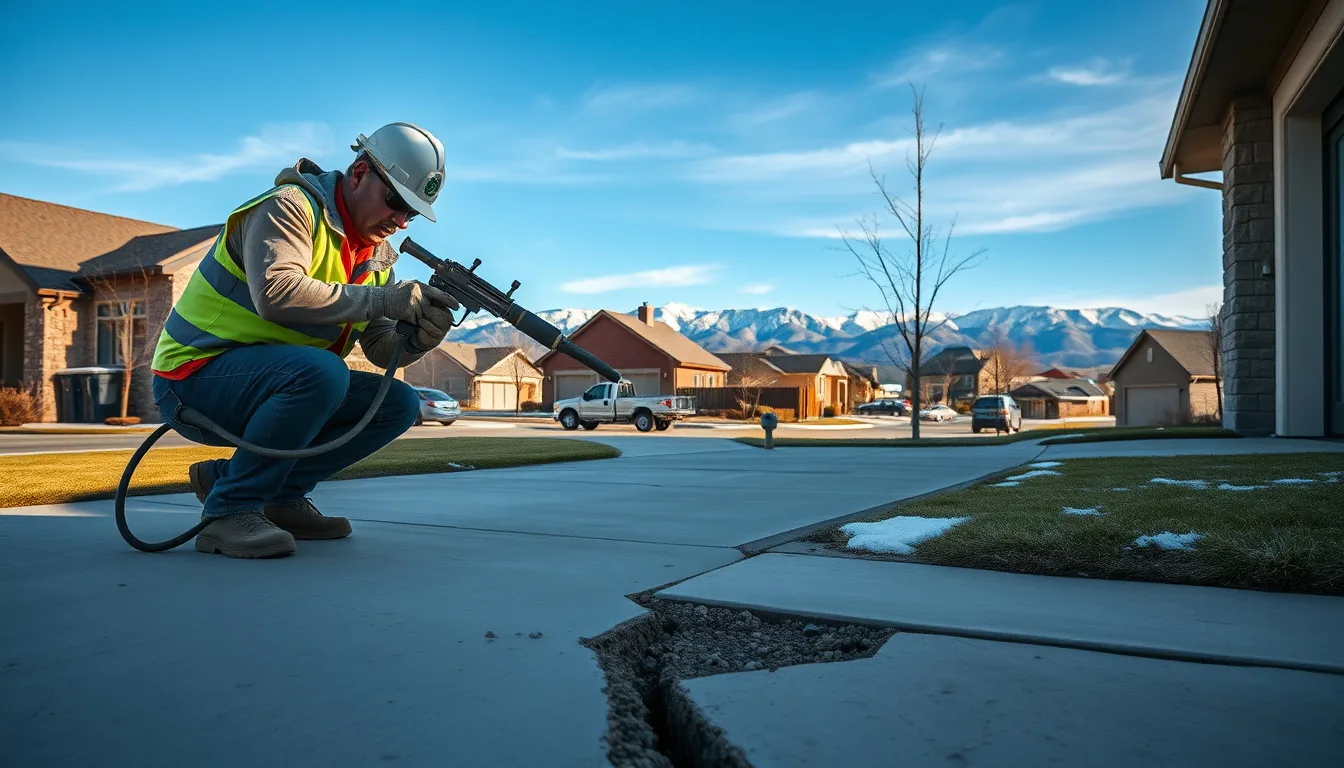
Lifting & Leveling — Denver Metro
Concrete Lifting & Leveling in Denver Metro — Raise Sunken and Heaved Slabs Without Replacement
Denver's expansive clay doesn't just crack concrete — it lifts and drops it unevenly across seasons. We raise sunken and heaved slabs back to level without tearing them out.
Signs Your Slab Needs Lifting, Not Just Patching
An uneven slab shows up in a few consistent patterns. One section of a driveway or walkway sits noticeably lower than the section next to it, creating a lip or step at the joint. A patio slab has pulled away from the house, leaving a gap that lets water run toward the foundation instead of away from it. Or an entire slab has tilted, pooling water in one corner after every rain.
Any vertical offset of a quarter inch or more at a walking surface is a federally recognized ADA trip hazard, and it's usually the first thing homeowners and property managers notice — a toe catching a raised sidewalk edge, or a wheelchair or stroller unable to cross a step at a driveway joint. These symptoms mean the slab has moved out of plane with what's around it, which patching the surface won't fix. Lifting addresses the position of the slab itself, not just its surface condition.
Denver's Cause: Expansive Clay, Not Loose Fill
Concrete goes uneven for different reasons in different climates, and Denver's is specifically clay. Denver, Aurora, Lakewood, Arvada, Westminster, and Centennial sit on Pierre Shale containing montmorillonite clay, which swells dramatically when wet and shrinks when dry — documented seasonal ground movement of roughly 2 to 6 inches, tracked by the Colorado Geological Survey. A slab can heave upward during a wet spring and then drop back down as the clay dries out later in the year, and because different sections of a driveway or patio don't always dry and swell perfectly evenly, the result is an uneven surface rather than a uniform lift.
Freeze-thaw frost heave is the secondary cause, especially in late winter: water in the soil beneath a slab freezes and expands, lifting a section of concrete, then thaws unevenly as temperatures swing through Denver's roughly 149 annual freeze-thaw cycles. This is usually a smaller-magnitude, more localized effect than clay heave, but it compounds the same unevenness, particularly at slab edges and joints where water collects.
This is a meaningfully different situation than settlement caused by loose or poorly compacted fill, which is a one-time, one-directional sinking. Denver-metro slabs on active clay are more often moving in both directions over time, which is worth understanding honestly before choosing a lifting method.
Mudjacking vs. Polyurethane Foam: A Direct Comparison
Mudjacking is the traditional lifting method: a cement-based slurry is pumped through holes roughly 1 to 2 inches wide drilled into the slab, filling voids underneath and raising the concrete as it's pumped in. It cures in 1 to 3 days, typically costs $3 to $6 per square foot, and generally lasts 5 to 10 years before it may need to be redone.
Polyurethane foam injection uses a much smaller entry point — dime-sized holes around 5/8 inch — to inject an expanding two-part foam that cures in about 15 minutes and reaches full strength almost immediately. It's dramatically lighter than mudjacking slurry, at roughly 2 pounds per cubic foot versus 100-plus pounds per cubic foot for mud, and typically costs $5 to $25 per square foot with a much longer expected lifespan than mudjacking.
- Mudjacking: 1–2" holes, 1–3 day cure, 100+ lb/cu ft, $3–$6/sq ft, 5–10 year lifespan
- Polyurethane foam: 5/8" holes, ~15 minute cure, ~2 lb/cu ft, $5–$25/sq ft, longer lifespan
Why Foam Matters More on Denver's Already-Unstable Clay
The weight difference between the two materials isn't a minor spec — it's the reason we lead with polyurethane foam on most Denver-metro clay-soil jobs. Mudjacking's heavy slurry effectively adds a new load on top of soil that's already actively swelling and shrinking, which on a stable, well-compacted subgrade is a non-issue, but on Pierre Shale clay can contribute to the same cyclical movement that caused the unevenness in the first place.
Polyurethane foam, at roughly 2 pounds per cubic foot, doesn't meaningfully reload the soil underneath. It fills voids and lifts the slab without adding significant new weight for the clay to support, which makes it the more durable choice specifically on the kind of active, moving ground common across Denver-metro subdivisions. It's also less invasive — smaller holes, faster cure, and it can typically bear full weight the same day.
Which Method Fits Your Situation
Mudjacking still has a place: it's less expensive up front, works well for large-area lifts where cost per square foot matters more than material weight, and is a reasonable choice on slabs where the underlying soil is stable rather than actively cycling. For driveways, sidewalks, and patios sitting directly on known expansive clay — which describes most Denver-metro flatwork — polyurethane foam is generally the better long-term investment despite the higher per-square-foot cost, because it won't add load back onto soil that's already moving.
We'll walk your specific situation with you during the inspection and recommend the method that fits your soil conditions and budget, rather than defaulting to one option across every job.
What Lifting and Leveling Costs by Project Type
A single sunken driveway section or sidewalk slab is typically the most affordable lifting job, since it's a smaller footprint and fewer injection points either way. Larger patios or multi-section driveways cost more in total but often see a lower blended rate per square foot, since mobilization and setup are spread across more area. Foam costs more than mud per square foot on any job, but the lifespan difference on active clay usually makes it the better value over a 10-plus year horizon rather than repeating a mudjacking lift twice in that span.
Drainage Correction: The Co-Fix That Makes the Lift Last
Lifting a slab without addressing where water goes around it is treating a symptom without the cause. Poor grading that channels roof runoff or yard water toward a driveway or patio's edge keeps the clay underneath saturated longer than it should be, driving the next round of swelling and unevenness.
As part of most lifting jobs, we look at grading and drainage around the slab — redirecting downspouts, correcting negative slope, or adding a drain where water is pooling against the concrete. Keeping water away from the clay doesn't stop it from swelling and shrinking seasonally, but it reduces the intensity of the cycle and extends how long a lift holds before it needs revisiting.
Honest Scoping: When Clay Keeps Cycling
We'd rather tell you this up front than have it be a surprise later: on a property with unusually active expansive clay, a lift can settle back out of level after a severe wet-to-dry swing, even with the right method and good drainage work. This isn't a defect in the repair — it's the nature of building on Pierre Shale, and it's the same reason engineered pier foundations exist for houses in these neighborhoods while driveways and patios simply don't get that protection.
Polyurethane foam and proper drainage correction meaningfully reduce how often this happens compared to mudjacking alone, but on the most active sites we'll say plainly that a re-level in future years is a realistic possibility rather than promising a one-and-done fix we can't actually guarantee.
Get a Lifting and Leveling Estimate in Denver Metro
Send us photos of the uneven section and your city, or book a free on-site inspection. We'll measure the offset, assess your soil and drainage situation, and recommend mudjacking or polyurethane foam with an honest explanation of why — then give you a fixed price before any drilling starts.
Get in touch through our contact form. We serve Denver, Aurora, Lakewood, Arvada, Westminster, Thornton, Centennial, Highlands Ranch, Littleton, Englewood, and Wheat Ridge.
Lifting & Leveling FAQs
Straight answers before we drill
Mudjacking pumps a cement-based slurry through 1–2" holes to lift a slab, costs $3–$6 per square foot, and lasts roughly 5–10 years. Polyurethane foam injects an expanding foam through dime-sized 5/8" holes, cures in about 15 minutes, weighs roughly 2 lb per cubic foot versus mud's 100-plus, costs $5–$25 per square foot, and typically lasts significantly longer.
Denver-metro soil is active expansive clay that swells and shrinks seasonally. Mudjacking's heavy slurry adds meaningful new weight onto that already-moving soil, while polyurethane foam's much lighter weight doesn't reload the clay the same way, making it more durable specifically on this kind of ground.
On most Denver-metro properties, a proper lift with drainage correction holds for years. On sites with unusually active clay movement, a severe wet-to-dry swing can occasionally require a re-level — we'll tell you honestly during the inspection if your soil conditions suggest that's a realistic possibility.
Mudjacking typically runs $3–$6 per square foot and polyurethane foam runs $5–$25 per square foot, with the final price depending on how much area needs lifting and how many injection points the job requires.
Yes, in most cases. Lifting raises the sunken side back toward level, closing or reducing the gap. We'll also check grading around that gap, since water channeling toward the foundation through it is often what caused the settling in the first place.
Cracked, sinking, or salt-damaged concrete? Get a fixed price before we drill.
Free inspections across the Denver metro. We diagnose freeze-thaw, de-icing salt, and expansive bentonite-clay causes before recommending a repair.