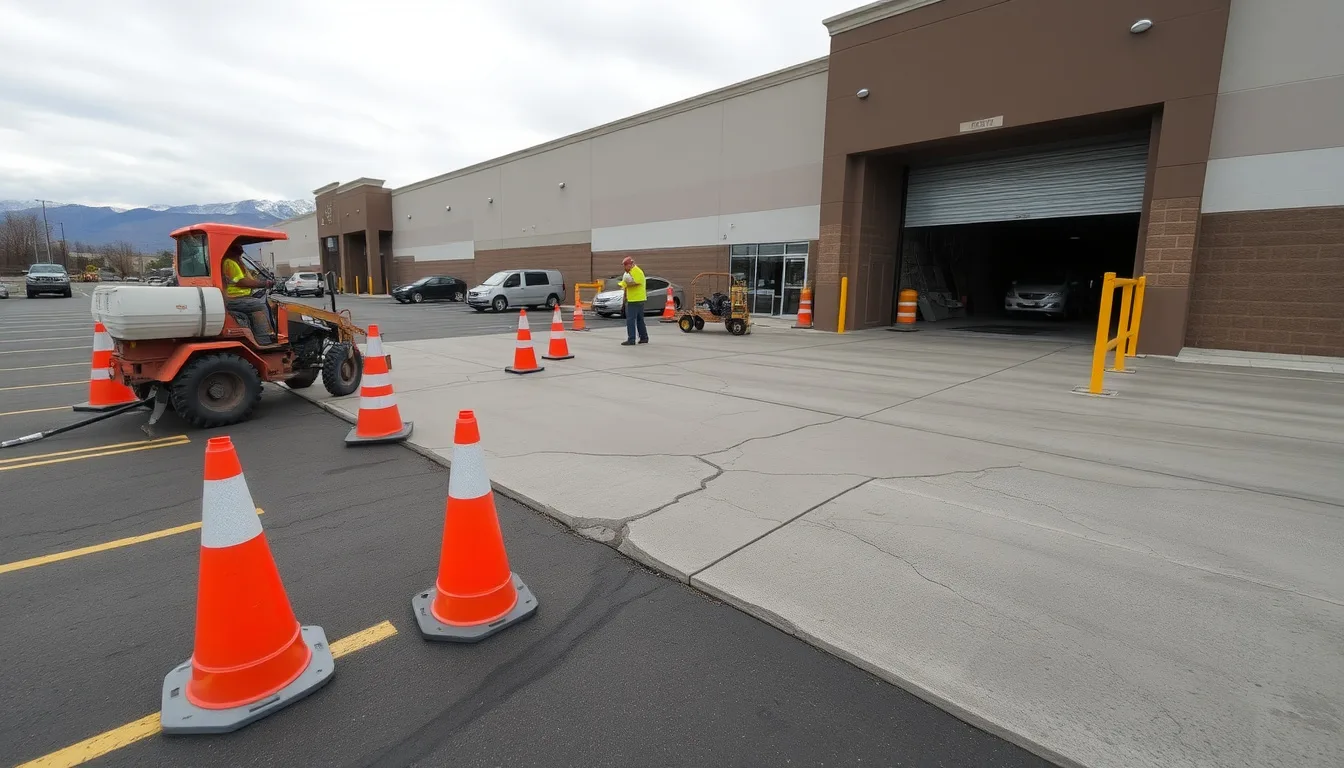
COMMERCIAL CONCRETE REPAIR
Denver Commercial Concrete Repair — ADA Compliance and Lot Repair on Your Schedule
Commercial concrete across the Denver metro takes more salt, more traffic, and more differential settlement than any residential property — and it stays fully your responsibility whether or not it's inside Denver city limits.
Who We Serve Across the Denver Metro
We work with retail centers and standalone storefronts managing customer-facing parking lots and entry walkways, HOA boards responsible for common-area concrete across townhome and condo developments, municipal and school properties with high foot-traffic sidewalks and lots, and warehouse and light-industrial sites where forklift and heavy-truck traffic put different stress on a slab than a passenger-vehicle lot does.
That range matters because the failure patterns differ by property type. A retail lot's biggest concern is usually customer-facing trip hazards near the entrance; a warehouse floor's biggest concern is usually load-bearing cracking under repeated heavy equipment traffic; an HOA's biggest concern is usually the sheer square footage of common-area walkway and lot to track across dozens of units. We scope each property type differently rather than applying one lot-repair template to all of them.
Why Commercial Concrete Fails Faster Than Residential
Commercial properties across the Denver metro generally take a heavier de-icing-salt load than residential lots — larger paved areas mean more total chloride applied per storm event, and liability concerns around customer and employee safety push property managers toward more aggressive, more frequent salting than a typical homeowner applies to a driveway. Magnesium chloride, Denver's most common de-icer, produces meaningfully worse scaling in testing than calcium chloride, and commercial lots get more of it, more often.
Scale works against commercial concrete in a second way too. A larger paved surface means more total expansion joints, and each joint is a stress point during the Front Range's roughly 149 annual freeze-thaw cycles — more joints mean more places for cracking to start. And a bigger lot spans more variation in the expansive Pierre Shale clay underneath it, so differential settlement across a large commercial slab tends to be more pronounced than across a single residential driveway sitting on a much smaller, more uniform footprint of soil.
ADA Trip-Hazard Compliance and Documentation
Commercial properties carry real legal exposure around trip hazards that residential properties generally don't face in the same way — customers, employees, and the public are on this concrete daily, and a documented pattern of ignored hazards is a materially worse position than an isolated incident. The federal ADA standard is unambiguous: any vertical change of 1/4 inch or more between adjoining concrete sections is a trip hazard, with a 1:2 bevel allowed only between 1/4 and 1/2 inch, and anything beyond that requiring re-leveling or a ramp.
We offer a structured trip-hazard survey and documentation program for commercial clients — a full walk of the property measuring every panel edge against the ADA standard, with a written record of what was found and what was repaired. That documentation matters twice over: it drives an efficient, prioritized repair plan, and it gives a property owner or manager a defensible paper trail showing hazards were identified and addressed rather than ignored.
Denver's Ordinance 307 Does Not Cover Your Commercial Lot
For commercial property owners specifically inside Denver city limits, it's worth being precise about what Ordinance 307 does and doesn't change. Passed by Denver voters in November 2022, Ordinance 307 shifted construction and maintenance responsibility for the public sidewalk in the city right-of-way to the City of Denver, funded through a Sidewalk Enterprise fee. That shift applies to the public sidewalk section along the street frontage.
It does not extend to private commercial property — your parking lot, your private walkways connecting the lot to your entrance, or any interior common-area concrete. All of that remains entirely the property owner's responsibility in Denver just as in every other Denver-metro city, Ordinance 307 or not. We flag this distinction specifically for Denver-proper commercial clients so there's no assumption that the ordinance covers more of the property than it actually does.
Minimal-Downtime Scheduling: Overnight and Weekend Work
A retail lot, warehouse dock, or municipal facility generally can't afford to close a section of parking or walkway during business hours without real revenue or operational impact, which is why commercial repair work is scheduled around the property's actual traffic patterns rather than a standard weekday window. Overnight and weekend scheduling is standard for commercial jobs, letting concrete cure through low-traffic hours and reopening the section before the next business day.
For larger lots or multi-phase repairs, we can also sequence work section by section, keeping the majority of a lot open throughout the project rather than closing the whole property at once — particularly relevant for retail centers that can't tolerate a fully blocked lot even overnight, or warehouses running multi-shift operations with limited true downtime.
Cost and the Commercial Inspection Process
Commercial concrete repair is priced by scope, not a flat per-property rate, because the range of possible work — crack sealing, section replacement, resurfacing, full lot leveling — varies enormously by property size and damage extent. Crack repair follows standard linear-foot pricing similar to residential work, while lot-scale resurfacing, replacement, and lifting are priced per square foot or by section based on the inspection findings.
Every commercial quote starts with an on-site walk of the full property, not a phone estimate — we measure trip-hazard edges against the ADA standard, assess crack severity and pattern across the lot, and identify any drainage or ponding issues tied to settlement. That walk produces a prioritized, itemized repair plan a property manager or HOA board can review and phase as budget allows.
Free Commercial Property Assessments Across the Denver Metro
Whether you're managing a retail center in Aurora, an HOA's common areas in Highlands Ranch, a municipal or school property in Denver, or a warehouse lot in Thornton or Wheat Ridge, we'll walk the full property, document every trip-hazard and structural concern, and put together a phased, fixed-price repair plan scheduled around your operating hours. We cover Denver, Aurora, Lakewood, Arvada, Westminster, Thornton, Centennial, Highlands Ranch, Littleton, Englewood, and Wheat Ridge.
Get in touch through our contact form to schedule a free commercial property assessment and start building the documentation and repair plan your property needs.
Commercial Concrete Repair FAQs
Straight answers before we drill
No. Ordinance 307 shifted responsibility for the public sidewalk in the city right-of-way to the City of Denver. It does not extend to private commercial property — your parking lot, entrance walkways, and any interior common-area concrete remain entirely your responsibility as the property owner, in Denver just as in any other Denver-metro city.
Yes — we run a structured trip-hazard survey measuring every panel edge against the federal ADA 1/4-inch standard, with a written record of findings and repairs. That documentation supports both an efficient repair plan and a defensible record that hazards were identified and addressed.
Yes, overnight and weekend scheduling is standard for commercial jobs, allowing concrete to cure during low-traffic hours so the section reopens before the next business day. For larger lots, we can also phase work section by section to keep most of the property open throughout the project.
Larger paved surfaces mean heavier total de-icing-salt application, more expansion joints exposed to freeze-thaw stress, and more variation in the expansive clay soil underneath a bigger footprint — all of which accelerate cracking and differential settlement compared to a smaller residential slab.
By scope rather than a flat rate, since commercial jobs range from isolated crack sealing to full lot resurfacing or section replacement. Every quote follows an on-site walk of the property measuring ADA compliance, crack severity, and drainage issues, producing an itemized, phased repair plan.
Cracked, sinking, or salt-damaged concrete? Get a fixed price before we drill.
Free inspections across the Denver metro. We diagnose freeze-thaw, de-icing salt, and expansive bentonite-clay causes before recommending a repair.