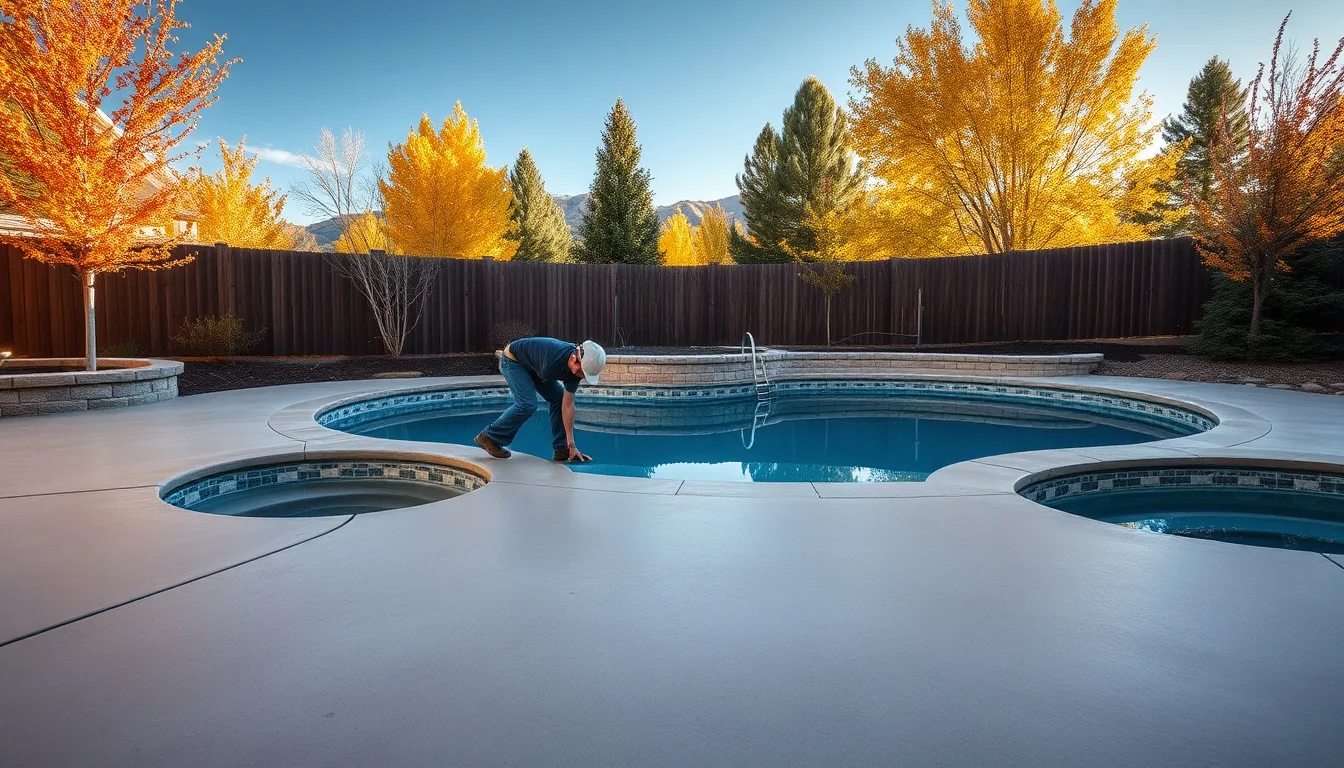
POOL DECK REPAIR
Denver Pool & Hot Tub Deck Repair — Keep the Slab From Tilting Toward the Shell
A pool or hot tub deck sits on the same backfilled excavation as the shell underneath it, which makes it one of the most active slabs on a Denver-metro property when the clay moves.
Built Over the Same Disturbed Soil as the Pool Itself
When a pool or hot tub goes in, the excavation for the shell gets backfilled around its perimeter, and the deck is poured directly over that backfilled zone. That soil is rarely as densely and uniformly compacted as undisturbed native ground, and on the Front Range it's also sitting on or mixed with the same bentonite-bearing Pierre Shale clay that defines Denver-metro geology — swelling as much as 2 to 6 inches seasonally as it absorbs and loses moisture.
The result is a deck slab that tends to move more, and less predictably, than flatwork poured over undisturbed soil elsewhere on the same lot. A driveway or front walkway might show gradual, fairly even settlement over years; a pool deck poured over backfill often shows sudden, localized heave or drop right where the excavation trench used to be, producing an uneven ring around the pool rather than a uniform tilt.
The Real Danger: A Deck Tilting Toward the Water
The specific failure pattern that matters most on a pool or hot tub deck is a slab tilting toward the shell rather than away from it. A deck is built to shed water outward, away from the pool, so splash-out and rain don't pool at the coping edge or seep down between the deck and the shell wall. When backfill settlement or clay heave tilts a deck section inward, that drainage reverses.
Beyond the drainage problem, an inward-tilting deck section next to a pool or raised hot tub is a genuine footing hazard — a lip or slope right at the water's edge is exactly the kind of trip-and-fall risk that matters most where people are barefoot, wet, and moving around a hard edge. We treat deck sections adjoining the coping as a priority on every inspection, not just a cosmetic concern.
De-Icing Salt Around Hot Tubs and Spas Kept Ice-Free All Winter
Unlike a pool, which most Denver-metro homeowners drain or close for winter, a hot tub or spa often stays in active use through the cold months, which means the deck around it gets salted repeatedly to keep the walking surface ice-free for year-round access. That concentrated, repeated de-icing-salt application puts a hot-tub deck through a heavier chloride load than most other backyard concrete on the property.
Denver's standard de-icers, magnesium chloride and calcium chloride, don't perform equally on concrete — a 4% magnesium chloride solution produces moderate scaling around a 3.1 rating in testing, versus roughly 1.6 for an equivalent calcium chloride solution. On a deck that also gets constant splash-out moisture from spa use, that chloride combines with saturated concrete to accelerate the same pitting and scaling pattern seen on heavily salted sidewalks, concentrated in the walking path around the spa's access point.
Lifting and Leveling vs. Resurfacing: Preserving the Decorative Finish
Pool decks are frequently stamped, stained, or exposed-aggregate finishes — a decorative surface that's expensive to replace and difficult to match exactly if a section is torn out and repoured. That makes polyurethane foam lifting the preferred fix whenever the underlying problem is settlement or heave rather than surface damage: foam injected through small entry holes raises the displaced section back to grade without disturbing the decorative finish on top.
When the damage is at the surface — scaling, pitting, or a worn decorative coating rather than a structural tilt — resurfacing with a bonded overlay is usually the better call, and it's also the moment to renew or update the decorative finish if it's faded or chipped from years of sun and chlorine exposure. We assess which category a given deck section falls into before recommending either approach, since lifting a slab that actually needs resurfacing (or vice versa) doesn't solve the underlying issue.
Denver Suburban Backyards: Highlands Ranch, Centennial, Littleton
Pool and hot tub density is notably high across specific Denver-metro suburbs — Highlands Ranch, Centennial, and Littleton in particular have a large share of backyard pools and spas relative to older Denver neighborhoods, many installed during the same development wave and sitting on comparable backfill conditions. That means deck settlement issues in these areas often follow recognizable patterns tied to a subdivision's original excavation and compaction practices rather than one-off soil anomalies.
For homeowners in these suburbs, that's useful context during an inspection — if a neighbor's deck on the same street has shown similar coping-edge heave, it's often worth having your own deck checked proactively rather than waiting for a visible tilt, since backfill-driven settlement tends to progress gradually before it becomes an obvious problem.
Typical Pool Deck Repair Costs
Crack repair on pool decks follows standard flatwork pricing: hairline cracks run roughly $5 to $8 per linear foot for sealant, wider cracks needing chiseled filler run about $8 to $15 per linear foot, and structural cracks with epoxy injection run $15 to $25-plus per linear foot. Lifting and leveling a settled or heaved section is typically priced by the job, based on the size of the area and how much foam injection is needed to restore grade and drainage.
Resurfacing to address scaling or refresh a decorative finish is priced per square foot and depends on the overlay and finish system chosen. Because pool decks often mix structural and cosmetic considerations, we quote every job after an on-site inspection rather than a phone estimate.
Free Pool & Hot Tub Deck Inspections Across the Denver Metro
If your pool or hot tub deck is tilting toward the water, cracking near the coping, or showing salt-scaling around a spa's access point, we'll inspect the full deck — checking drainage direction, measuring settlement at the shell perimeter, and identifying whether lifting or resurfacing is the right fix. We serve Denver, Aurora, Lakewood, Arvada, Westminster, Thornton, Centennial, Highlands Ranch, Littleton, Englewood, and Wheat Ridge.
Get in touch through our contact form to schedule a free deck inspection before an inward tilt near the water turns into a bigger hazard or a bigger repair.
Pool Deck Repair FAQs
Straight answers before we drill
A pool deck sits directly over the backfilled excavation used to install the pool shell, which is typically less densely compacted than undisturbed soil and sits on the same expansive Pierre Shale clay that defines Denver-metro geology. That combination produces more localized, less predictable settlement than flatwork poured over undisturbed ground elsewhere on the property.
Yes, in two ways. It reverses the deck's intended drainage, letting water pool at the coping edge and seep down along the shell wall instead of draining away. It also creates a footing hazard right at the water's edge, where people are typically barefoot and wet — exactly the wrong place for an uneven lip or slope.
Not if lifting is the right fix. Polyurethane foam is injected through small entry holes to raise a settled section back to grade without disturbing the decorative surface on top. Resurfacing, used when the damage is at the surface rather than structural, is also a chance to renew a faded or chipped decorative finish.
Hot tubs and spas often stay in use through the winter, so the surrounding deck gets salted repeatedly to keep it ice-free for year-round access. A pool, by contrast, is usually closed or drained for winter and doesn't get that repeated de-icing treatment, so its deck typically takes less chloride exposure over a season.
Yes — Highlands Ranch, Centennial, and Littleton have a high concentration of backyard pools and spas, often installed during the same development wave with comparable backfill conditions, and we regularly see recognizable settlement patterns across a given subdivision. We inspect and repair decks throughout these areas as part of our full Denver-metro service area.
Cracked, sinking, or salt-damaged concrete? Get a fixed price before we drill.
Free inspections across the Denver metro. We diagnose freeze-thaw, de-icing salt, and expansive bentonite-clay causes before recommending a repair.