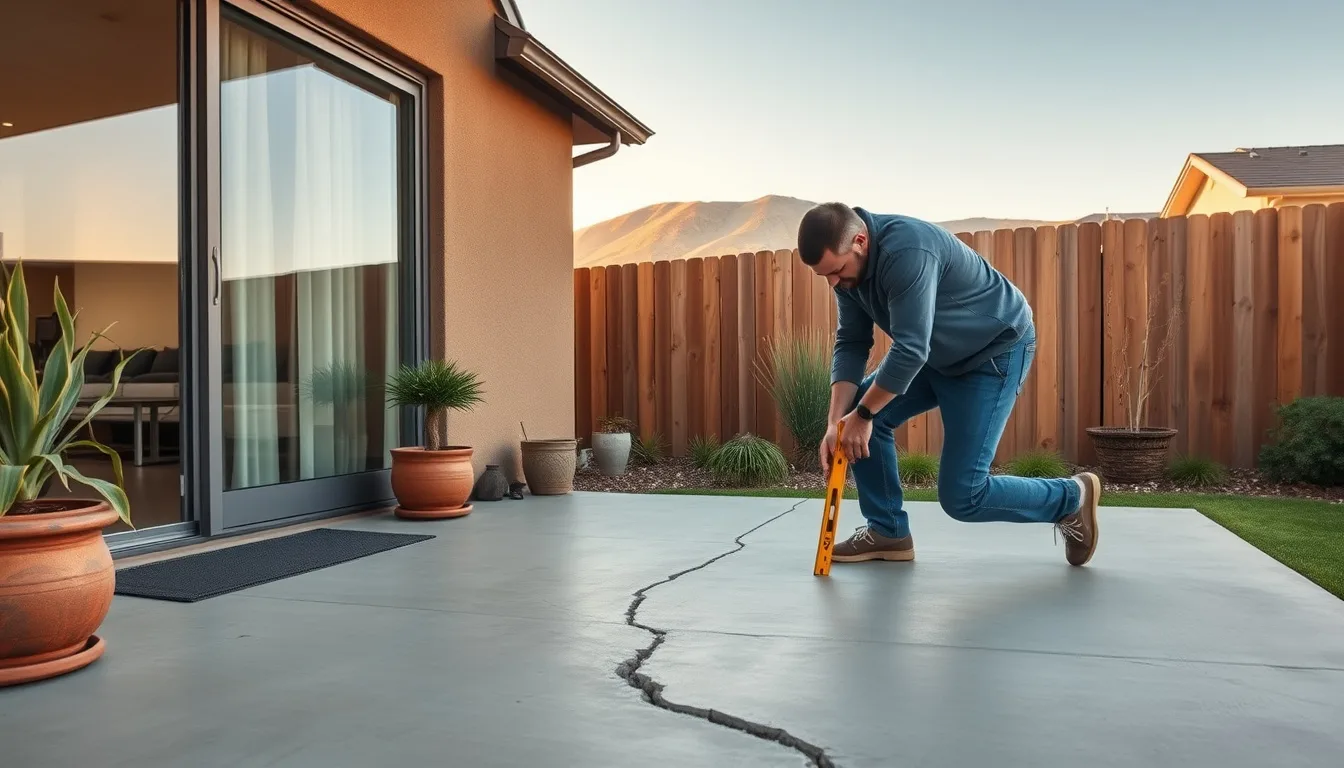
PATIO REPAIR
Denver Patio Repair — Fix Tilting, Cracking, and Drainage Before It Reaches the Foundation
A patio sits directly on backfill against your foundation stem wall — the single spot where Denver's expansive clay moves the most, and the last place you want water pooling back toward the house.
Why Patios Move More Than Almost Any Other Slab on the Property
Most concrete flatwork on a Denver-metro property — a driveway, a sidewalk — sits over native or lightly disturbed soil. A patio is different. It's typically poured directly against the house, over soil that was excavated during the foundation dig and then backfilled, often less densely compacted than the ground around it. That backfilled zone is exactly where Denver's expansive clay does its most dramatic work.
The bentonite-bearing Pierre Shale that underlies most of the Front Range swells when it absorbs moisture and shrinks as it dries, with documented seasonal movement of roughly 2 to 6 inches. Backfill soil, being looser and more permeable than undisturbed native clay, tends to wick moisture faster and swell more unevenly — which is why a patio poured against a foundation often shows movement well before a driveway on the same lot does.
The Tilt-Toward-the-House Problem
The failure pattern we see most often on Denver patios isn't a flat slab sinking evenly — it's one edge, usually the edge closest to the foundation, heaving up while the outer edge stays put or drops slightly. That tilts the whole slab toward the house instead of away from it, which reverses the drainage slope a patio is supposed to have.
A patio is built to shed water away from the foundation at a slight grade, typically around 1/4 inch per foot. Once expansive clay lifts the house-side edge, that slope runs backward, and rainwater or snowmelt that should be draining into the yard instead pools against the stem wall — the exact condition that drives moisture into a basement or crawlspace and accelerates further clay swelling right where you least want it.
Freeze-Thaw Damage Lingers Longer on a Patio
The Front Range runs through roughly 149 freeze-thaw cycles in a typical year, and each cycle expands trapped water in concrete's pore structure by about 9%, widening existing cracks a little further every time. A driveway sees regular vehicle traffic that helps break up and clear snow and ice; a patio, especially through a Denver winter when nobody's using the backyard, often sits under snow and ice undisturbed for days or weeks at a stretch.
That extra dwell time means a patio slab spends more total hours saturated and freezing than a comparable driveway section, which is part of why patios in Denver-metro backyards frequently show more surface scaling and cracking than the driveway out front on the same property, even though both are exposed to the same weather.
Crack, Heave, Resurface, or Lift: Matching the Fix to the Damage
A hairline or moderate crack in an otherwise flat, stable patio slab gets sealed or epoxy-injected — quick, and it stops water intrusion that would otherwise widen the crack over the next freeze-thaw season. Surface scaling or pitting across an otherwise structurally sound slab is a resurfacing candidate: a bonded overlay restores a smooth, even surface without full replacement.
When the slab itself has tilted, heaved, or settled unevenly — the drainage-reversal scenario common on Denver patios — polyurethane foam lifting is usually the right call. Foam is injected through small entry holes to raise the low or displaced sections back to grade, re-establishing the slope away from the house without demolishing the existing slab or disturbing surrounding landscaping and hardscape.
Re-Establishing Positive Drainage Slope
Fixing the crack or the crooked panel is only half the job if the underlying slope problem isn't corrected — a patio that's re-leveled flat, without restoring the pitch away from the foundation, will just start pooling water again the next time the clay underneath shifts. When we lift a patio, we grade the repair to restore drainage flowing away from the stem wall, not just to make the surface look even.
For patios where the original pour never had adequate slope to begin with — common on older Denver-metro homes — we'll flag that during inspection, since a lift-and-level repair is a good opportunity to correct a drainage problem that predates the current cracking, not just patch around it.
Denver's Dense Backyards Mean More Patio Per Lot
Denver-metro subdivisions — from established Denver neighborhoods to newer Highlands Ranch and Centennial developments — pack more finished outdoor living space onto a comparable lot than a rural property typically has, and a bigger share of that space is often poured concrete rather than open ground. More patio square footage sitting on the same active clay means more total joints, more total edges, and more opportunities for differential movement across a single slab.
That density also means patio damage is rarely isolated — a crack pattern that starts near the house frequently connects to movement affecting an attached walkway or a nearby pool deck on the same lot, which is why we inspect the full backyard hardscape as one connected system rather than quoting a single crack in isolation.
Typical Patio Repair Costs
Crack repair pricing follows standard flatwork rates: hairline cracks run roughly $5 to $8 per linear foot for sealant, wider cracks needing chiseled filler run about $8 to $15 per linear foot, and structural cracks with epoxy injection run $15 to $25-plus per linear foot. Resurfacing an entire patio to correct scaling or pitting is typically priced per square foot and depends on the overlay system used and the size of the slab.
Lifting and leveling a tilted or heaved patio section is usually priced by the job based on square footage and how much foam is needed to restore grade, since that number depends heavily on how uneven the slab has become and how large an area needs correcting. We quote every patio job after an on-site inspection rather than a phone estimate.
Free Patio Inspections Across the Denver Metro
If your patio is cracking, tilting toward the house, or holding water where it used to drain away, we'll come inspect it — measuring the current slope, checking for structural cracking, and identifying whether the fix is a simple crack seal or a full lift-and-level to restore drainage. We serve Denver, Aurora, Lakewood, Arvada, Westminster, Thornton, Centennial, Highlands Ranch, Littleton, Englewood, and Wheat Ridge.
Get in touch through our contact form to schedule a free patio inspection and get a fixed-price repair plan before the next freeze-thaw season does more damage to a slab that's already moving.
Patio Repair FAQs
Straight answers before we drill
Patios are poured over backfilled soil against the foundation, which is where Denver's expansive Pierre Shale clay moves the most as it swells and shrinks seasonally. When the house-side edge of the slab heaves up more than the outer edge, the drainage slope reverses and water that should flow into the yard pools against the foundation instead. Lifting and re-leveling the slab restores the correct pitch.
Most Denver-metro patios don't need full replacement. Hairline or moderate cracks in an otherwise flat slab get sealed or epoxy-injected. Surface scaling or pitting on a structurally sound slab is a resurfacing candidate. A tilted, heaved, or unevenly settled slab typically needs polyurethane foam lifting rather than replacement. Full replacement is reserved for slabs with extensive structural cracking or badly deteriorated concrete.
A patio usually sits over looser backfill soil directly against the foundation, where Denver's expansive clay swells and shrinks the most. It also gets no vehicle traffic to clear snow and ice, so it holds moisture through more of the Front Range's roughly 149 annual freeze-thaw cycles than a regularly driven driveway does.
In most cases, yes. Polyurethane foam lifting raises a settled or tilted slab back to grade through small entry holes, without demolishing the existing concrete or disturbing surrounding landscaping. Full replacement is only necessary when the slab has extensive structural cracking or deteriorated concrete that leveling can't correct.
We look at the full connected hardscape — patio, any attached walkway, and nearby pool deck if present — since movement in Denver's expansive clay rarely stays isolated to one slab. That gives you one accurate repair plan instead of separate quotes for cracks that are actually part of the same underlying issue.
Cracked, sinking, or salt-damaged concrete? Get a fixed price before we drill.
Free inspections across the Denver metro. We diagnose freeze-thaw, de-icing salt, and expansive bentonite-clay causes before recommending a repair.