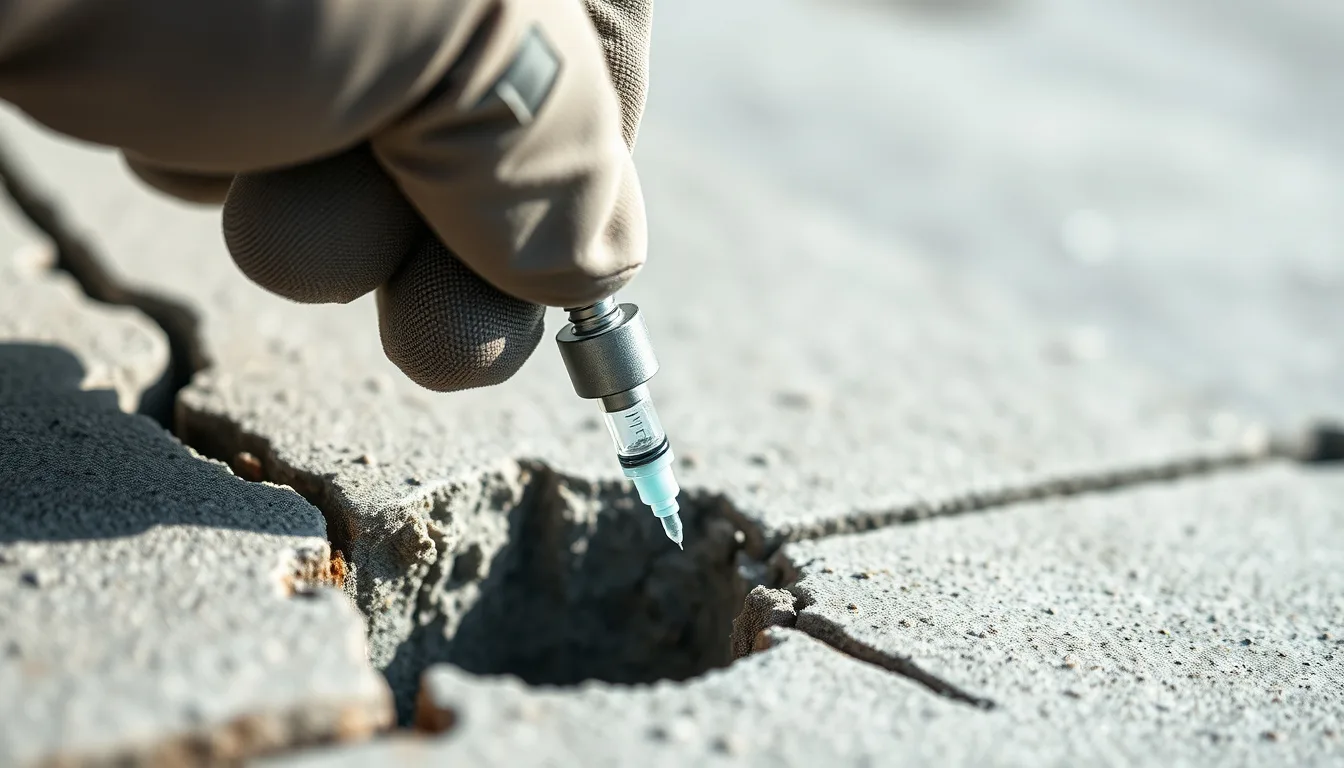
Crack Repair & Injection — Denver Metro
Concrete Crack Repair & Injection in Denver Metro — Stop Cracks Before Clay Heave and Freeze-Thaw Make Them Worse
A hairline crack in your driveway or patio today is a structural repair by next winter. We diagnose whether clay heave or freeze-thaw is driving it, then inject the right material to stop it for good.
Hairline Crack or Structural Crack? How to Tell the Difference
Not every crack on a Denver-metro driveway or walkway needs the same fix, and guessing wrong wastes money either way. A hairline crack is typically under 1/8 inch wide, holds roughly the same width along its entire run, and shows no vertical lip from one side to the other. These are usually cosmetic — a byproduct of normal shrinkage as the concrete cured — and don't threaten the slab's strength.
A structural crack behaves differently. It's often 1/4 inch or wider, changes width along its length, runs diagonally out of a corner, or has a noticeable step where one side sits higher than the other. In a dense Denver subdivision, that pattern almost always means something underneath the slab is actively moving it — expansive clay swelling with the season, a settling void, or repeated freeze-thaw stress — not just curing shrinkage.
The test that actually settles it: mark both ends of the crack with a pencil and check again after a wet spring or a hard freeze. If it's grown, you're dealing with an active crack that needs its underlying cause addressed, not just a cosmetic fill job.
Denver's Two Crack Causes, and Why an Urban Lot Sees More of Them
Denver-metro concrete cracks for one of two reasons, and often both at once. The first is expansive clay soil. Denver, Aurora, Lakewood, Arvada, Westminster, Thornton, and Centennial all sit on Pierre Shale and bentonite-bearing claystone containing montmorillonite, a clay mineral that swells when wet and shrinks when dry, with documented seasonal ground movement of roughly 2 to 6 inches in affected areas — figures tracked by the Colorado Geological Survey. Homes in these subdivisions are commonly built on drilled pier foundations that reach stable bedrock below the clay, but driveways, patios, walkways, and garage slabs are almost never on piers, so they heave and crack with the clay even when the house itself stays put.
What makes this more visible inside Denver's dense inner- and second-ring suburbs than it would be on a rural property is simple math: a typical Denver-metro lot in Highlands Ranch, Littleton, or Wheat Ridge packs more concrete flatwork per acre than a spread-out exurban property — driveway, front walk, patio, and often a side path, all sitting on the same active Pierre Shale. More concrete on the same clay means more visible cracking and heave complaints concentrated across these neighborhoods, which is exactly the pattern we see block by block.
The second cause is freeze-thaw cycling. The Front Range averages roughly 149 freeze-thaw cycles a year — far more than Minneapolis (about 120) or Chicago (about 100) — because Denver's cold nights paired with 300-plus days of annual sunshine mean concrete thaws and refreezes repeatedly all winter. Water trapped inside an existing crack expands about 9% in volume every time it freezes, prying the crack a little wider each cycle.
Before we recommend a repair method, we diagnose which mechanism is driving a given crack. Pattern, location on the lot, and seasonal behavior all point one way or the other, because clay-driven cracks and freeze-thaw cracks call for different injection materials.
Epoxy Injection for Structural, Static Cracks
When a crack has stopped actively moving — the slab underneath is stable and the crack width has held steady across a season — epoxy injection is the strongest repair available. High-strength epoxy resin is injected under pressure through surface ports along the crack, filling it from the bottom up and bonding the two faces back into essentially one solid piece.
Epoxy restores structural continuity, not just a sealed appearance, which is why it's the standard choice for foundation cracks and load-bearing structural cracks in slabs that have finished settling. The tradeoff is that epoxy is rigid: it doesn't flex, so it's the wrong material for a crack that's still actively opening and closing with seasonal soil movement — a rigid fill next to still-moving clay will simply crack again right beside the repair rather than in it.
Flexible Polyurethane Injection for Active, Moving Cracks
Cracks over Denver-metro expansive clay often don't fully stop moving — they narrow and widen with the wet-dry swelling cycle year after year. Injecting a rigid epoxy into a crack like this is a common mistake: the fill holds, but the concrete on either side re-cracks the following season as the soil keeps cycling underneath it.
For these active cracks, we use flexible polyurethane injection instead. The material cures into a semi-rigid, elastic seal that expands and contracts with the crack rather than fighting it, keeping water out of the joint while tolerating the ongoing clay movement below. It's the right call for driveway and patio cracks in Denver's known expansive-clay neighborhoods, and for any crack where our inspection shows the width still changing seasonally.
Surface Caulking for Hairline, Cosmetic Cracks
Hairline cracks under about 1/8 inch generally don't need pressure injection at all. A flexible polyurethane or silicone caulk applied along the surface seals the crack against water intrusion — which matters specifically in Denver, because water sitting unsealed in a hairline crack is exactly what freeze-thaw cycling needs to turn a cosmetic crack into a structural one over a couple of winters.
Surface caulking is fast, inexpensive, and the right scope for garage floor shrinkage cracks, cosmetic patio cracks, and sidewalk hairlines that show no vertical offset or width change. We'll tell you plainly when a crack only needs this level of repair rather than upselling injection it doesn't require.
What Crack Repair Costs in Denver Metro
Cost scales with crack width and method, not just linear footage. Hairline cracks under 1/8 inch typically run about $5 to $8 per linear foot for caulk or sealant. Cracks in the 1/4 to 1/2 inch range typically run $8 to $15 per linear foot for chiseled-and-filled repair. Wider structural cracks over 1/2 inch, reinforced with epoxy or flexible polyurethane injection, typically run $15 to $25-plus per linear foot — a single structural epoxy injection job commonly lands around $250 to $500 total.
We give a fixed price after an on-site inspection, not a phone-quote guess, since the same-looking crack on the surface can mean very different scope underneath depending on whether clay movement or freeze-thaw is driving it. Crack injection is also almost always cheaper than it looks next to full replacement — keeping the existing slab and its finish typically costs a fraction of tearing out and repouring a section, which is why we default to injection and repair wherever the underlying concrete is still sound.
When Cracking Signals a Bigger Problem
Most cracks are a concrete-repair job, not a foundation-engineering job. But some patterns warrant a broader evaluation before we do any cosmetic work: multiple large diagonal cracks radiating from corners, a slab that has visibly heaved or dropped several inches, doors and windows that have started sticking in the same season the cracking appeared, or cracking that keeps returning in the same spot after repair.
In those cases, addressing drainage and grading around the slab — and in rare cases bringing in a structural evaluation — has to happen before crack repair will hold. We'll tell you honestly if that's what we're seeing rather than injecting a crack that's going to open right back up next season.
Get a Free Crack Diagnosis in Denver Metro
Send us a couple of photos of the crack and your city, or book a free on-site inspection anywhere across the Denver metro. We measure the width, check for movement, and tell you plainly whether you need caulk, epoxy, or flexible injection — then give you a fixed price before any drilling starts.
Get in touch through our contact form. If the crack is one symptom of a bigger heave or settlement problem, we handle that too — one visit, one honest diagnosis.
We dispatch crews across Denver, Aurora, Lakewood, Arvada, Westminster, Thornton, Centennial, Highlands Ranch, Littleton, Englewood, and Wheat Ridge — the dense Front Range urban corridor sitting squarely on the Pierre Shale belt driving this kind of cracking.
Crack Repair & Injection FAQs
Straight answers before we drill
Hairline cracks typically run about $5–$8 per linear foot for caulk or sealant, $8–$15 per linear foot for chiseled structural filler, and $15–$25-plus per linear foot for epoxy or flexible polyurethane injection on wider structural cracks. A single structural epoxy injection job commonly lands around $250–$500.
Most cracked slabs can be saved — the crack itself is rarely the structural problem, it's usually a symptom of clay movement or freeze-thaw stress underneath. Injecting and sealing the crack, and addressing the underlying cause such as heaving clay or poor drainage, typically restores the slab for years without a tear-out.
The Front Range averages around 149 freeze-thaw cycles a year — far more than most U.S. cities — because Denver's cold nights and 300-plus days of sunshine mean concrete thaws and refreezes repeatedly all winter. Each cycle, water trapped in the concrete's pores expands about 9% as it freezes, widening existing micro-cracks a little more every time. On top of that, dense Denver-metro subdivisions sit on expansive Pierre Shale clay, so cracking shows up on more of the flatwork per lot than a less concrete-dense property would see.
Denver-metro soil often sits on Pierre Shale and bentonite clay layers that swell dramatically when wet and shrink when dry, with documented seasonal ground movement of roughly 2–6 inches in affected areas. Your house may be on drilled piers reaching stable bedrock, but driveways, patios, walks, and garage slabs almost never are, so they move with the clay even when the house itself doesn't.
Yes — crack injection and interior garage floor work can be done in cold weather with the right materials, unlike exterior resurfacing or new-material curing, which needs temperatures reliably above freezing. That said, spring is still the highest-demand season across the Denver metro, since it's when the winter's freeze-thaw damage becomes visible and repairs can be finished before the next winter starts the cycle again.
Cracked, sinking, or salt-damaged concrete? Get a fixed price before we drill.
Free inspections across the Denver metro. We diagnose freeze-thaw, de-icing salt, and expansive bentonite-clay causes before recommending a repair.